Automatic Chemical Design Using a Datadriven Continuous Representation of Molecules Github

Drug Molecule Generation with VAE

Author: Victor Basu
Date created: 2022/03/10
Last modified: 2022/03/24
Description: Implementing a Convolutional Variational AutoEncoder (VAE) for Drug Discovery.

View in Colab GitHub source


Introduction

In this example, we use a Variational Autoencoder to generate molecules for drug discovery. We use the research papers Automatic chemical design using a data-driven continuous representation of molecules and MolGAN: An implicit generative model for small molecular graphs as a reference.

The model described in the paper Automatic chemical design using a data-driven continuous representation of molecules generates new molecules via efficient exploration of open-ended spaces of chemical compounds. The model consists of three components: Encoder, Decoder and Predictor. The Encoder converts the discrete representation of a molecule into a real-valued continuous vector, and the Decoder converts these continuous vectors back to discrete molecule representations. The Predictor estimates chemical properties from the latent continuous vector representation of the molecule. Continuous representations allow the use of gradient-based optimization to efficiently guide the search for optimized functional compounds.

intro

Figure (a) - A diagram of the autoencoder used for molecule design, including the joint property prediction model. Starting from a discrete molecule representation, such as a SMILES string, the encoder network converts each molecule into a vector in the latent space, which is effectively a continuous molecule representation. Given a point in the latent space, the decoder network produces a corresponding SMILES string. A multilayer perceptron network estimates the value of target properties associated with each molecule.

Figure (b) - Gradient-based optimization in continuous latent space. After training a surrogate model f(z) to predict the properties of molecules based on their latent representation z, we can optimize f(z) with respect to z to find new latent representations expected to match specific desired properties. These new latent representations can then be decoded into SMILES strings, at which point their properties can be tested empirically.

For an explanation and implementation of MolGAN, please refer to the Keras Example WGAN-GP with R-GCN for the generation of small molecular graphs by Alexander Kensert. Many of the functions used in the present example are from the above Keras example.


Setup

RDKit is an open source toolkit for cheminformatics and machine learning. This toolkit come in handy if one is into drug discovery domain. In this example, RDKit is used to conveniently and efficiently transform SMILES to molecule objects, and then from those obtain sets of atoms and bonds.

Quoting from WGAN-GP with R-GCN for the generation of small molecular graphs):

"SMILES expresses the structure of a given molecule in the form of an ASCII string. The SMILES string is a compact encoding which, for smaller molecules, is relatively human-readable. Encoding molecules as a string both alleviates and facilitates database and/or web searching of a given molecule. RDKit uses algorithms to accurately transform a given SMILES to a molecule object, which can then be used to compute a great number of molecular properties/features."

                                      !              pip              -              q              install              rdkit              -              pypi              ==              2021.9              .              4                      
                                      import              ast              import              pandas              as              pd              import              numpy              as              np              import              tensorflow              as              tf              from              tensorflow              import              keras              from              tensorflow.keras              import              layers              import              matplotlib.pyplot              as              plt              from              rdkit              import              Chem              ,              RDLogger              from              rdkit.Chem              import              BondType              from              rdkit.Chem.Draw              import              MolsToGridImage              RDLogger              .              DisableLog              (              "rdApp.*"              )                      
                             |████████████████████████████████| 20.6 MB 1.2 MB/s  [?25h                      

Dataset

We use the ZINC – A Free Database of Commercially Available Compounds for Virtual Screening dataset. The dataset comes with molecule formula in SMILE representation along with their respective molecular properties such as logP (water–octanal partition coefficient), SAS (synthetic accessibility score) and QED (Qualitative Estimate of Drug-likeness).

                                      csv_path              =              keras              .              utils              .              get_file              (              "/content/250k_rndm_zinc_drugs_clean_3.csv"              ,              "https://raw.githubusercontent.com/aspuru-guzik-group/chemical_vae/master/models/zinc_properties/250k_rndm_zinc_drugs_clean_3.csv"              ,              )              df              =              pd              .              read_csv              (              "/content/250k_rndm_zinc_drugs_clean_3.csv"              )              df              [              "smiles"              ]              =              df              [              "smiles"              ]              .              apply              (              lambda              s              :              s              .              replace              (              "              \n              "              ,              ""              ))              df              .              head              ()                      
                        Downloading data from https://raw.githubusercontent.com/aspuru-guzik-group/chemical_vae/master/models/zinc_properties/250k_rndm_zinc_drugs_clean_3.csv 22606589/22606589 [==============================] - 0s 0us/step                      
smiles logP qed SAS
0 CC(C)(C)c1ccc2occ(CC(=O)Nc3ccccc3F)c2c1 5.05060 0.702012 2.084095
1 C[C@@H]1CC(Nc2cncc(-c3nncn3C)c2)C[C@@H](C)C1 3.11370 0.928975 3.432004
2 N#Cc1ccc(-c2ccc(O[C@@H](C(=O)N3CCCC3)c3ccccc3)... 4.96778 0.599682 2.470633
3 CCOC(=O)[C@@H]1CCCN(C(=O)c2nc(-c3ccc(C)cc3)n3c... 4.00022 0.690944 2.822753
4 N#CC1=C(SCC(=O)Nc2cccc(Cl)c2)N=C([O-])[C@H](C#... 3.60956 0.789027 4.035182

Hyperparameters

                                      SMILE_CHARSET              =              '["C", "B", "F", "I", "H", "O", "N", "S", "P", "Cl", "Br"]'              bond_mapping              =              {              "SINGLE"              :              0              ,              "DOUBLE"              :              1              ,              "TRIPLE"              :              2              ,              "AROMATIC"              :              3              }              bond_mapping              .              update              (              {              0              :              BondType              .              SINGLE              ,              1              :              BondType              .              DOUBLE              ,              2              :              BondType              .              TRIPLE              ,              3              :              BondType              .              AROMATIC              }              )              SMILE_CHARSET              =              ast              .              literal_eval              (              SMILE_CHARSET              )              MAX_MOLSIZE              =              max              (              df              [              "smiles"              ]              .              str              .              len              ())              SMILE_to_index              =              dict              ((              c              ,              i              )              for              i              ,              c              in              enumerate              (              SMILE_CHARSET              ))              index_to_SMILE              =              dict              ((              i              ,              c              )              for              i              ,              c              in              enumerate              (              SMILE_CHARSET              ))              atom_mapping              =              dict              (              SMILE_to_index              )              atom_mapping              .              update              (              index_to_SMILE              )              BATCH_SIZE              =              100              EPOCHS              =              10              VAE_LR              =              5e-4              NUM_ATOMS              =              120              # Maximum number of atoms              ATOM_DIM              =              len              (              SMILE_CHARSET              )              # Number of atom types              BOND_DIM              =              4              +              1              # Number of bond types              LATENT_DIM              =              435              # Size of the latent space              def              smiles_to_graph              (              smiles              ):              # Converts SMILES to molecule object              molecule              =              Chem              .              MolFromSmiles              (              smiles              )              # Initialize adjacency and feature tensor              adjacency              =              np              .              zeros              ((              BOND_DIM              ,              NUM_ATOMS              ,              NUM_ATOMS              ),              "float32"              )              features              =              np              .              zeros              ((              NUM_ATOMS              ,              ATOM_DIM              ),              "float32"              )              # loop over each atom in molecule              for              atom              in              molecule              .              GetAtoms              ():              i              =              atom              .              GetIdx              ()              atom_type              =              atom_mapping              [              atom              .              GetSymbol              ()]              features              [              i              ]              =              np              .              eye              (              ATOM_DIM              )[              atom_type              ]              # loop over one-hop neighbors              for              neighbor              in              atom              .              GetNeighbors              ():              j              =              neighbor              .              GetIdx              ()              bond              =              molecule              .              GetBondBetweenAtoms              (              i              ,              j              )              bond_type_idx              =              bond_mapping              [              bond              .              GetBondType              ()              .              name              ]              adjacency              [              bond_type_idx              ,              [              i              ,              j              ],              [              j              ,              i              ]]              =              1              # Where no bond, add 1 to last channel (indicating "non-bond")              # Notice: channels-first              adjacency              [              -              1              ,              np              .              sum              (              adjacency              ,              axis              =              0              )              ==              0              ]              =              1              # Where no atom, add 1 to last column (indicating "non-atom")              features              [              np              .              where              (              np              .              sum              (              features              ,              axis              =              1              )              ==              0              )[              0              ],              -              1              ]              =              1              return              adjacency              ,              features              def              graph_to_molecule              (              graph              ):              # Unpack graph              adjacency              ,              features              =              graph              # RWMol is a molecule object intended to be edited              molecule              =              Chem              .              RWMol              ()              # Remove "no atoms" & atoms with no bonds              keep_idx              =              np              .              where              (              (              np              .              argmax              (              features              ,              axis              =              1              )              !=              ATOM_DIM              -              1              )              &              (              np              .              sum              (              adjacency              [:              -              1              ],              axis              =              (              0              ,              1              ))              !=              0              )              )[              0              ]              features              =              features              [              keep_idx              ]              adjacency              =              adjacency              [:,              keep_idx              ,              :][:,              :,              keep_idx              ]              # Add atoms to molecule              for              atom_type_idx              in              np              .              argmax              (              features              ,              axis              =              1              ):              atom              =              Chem              .              Atom              (              atom_mapping              [              atom_type_idx              ])              _              =              molecule              .              AddAtom              (              atom              )              # Add bonds between atoms in molecule; based on the upper triangles              # of the [symmetric] adjacency tensor              (              bonds_ij              ,              atoms_i              ,              atoms_j              )              =              np              .              where              (              np              .              triu              (              adjacency              )              ==              1              )              for              (              bond_ij              ,              atom_i              ,              atom_j              )              in              zip              (              bonds_ij              ,              atoms_i              ,              atoms_j              ):              if              atom_i              ==              atom_j              or              bond_ij              ==              BOND_DIM              -              1              :              continue              bond_type              =              bond_mapping              [              bond_ij              ]              molecule              .              AddBond              (              int              (              atom_i              ),              int              (              atom_j              ),              bond_type              )              # Sanitize the molecule; for more information on sanitization, see              # https://www.rdkit.org/docs/RDKit_Book.html#molecular-sanitization              flag              =              Chem              .              SanitizeMol              (              molecule              ,              catchErrors              =              True              )              # Let's be strict. If sanitization fails, return None              if              flag              !=              Chem              .              SanitizeFlags              .              SANITIZE_NONE              :              return              None              return              molecule                      

Generate training set

                                      train_df              =              df              .              sample              (              frac              =              0.75              ,              random_state              =              42              )              # random state is a seed value              train_df              .              reset_index              (              drop              =              True              ,              inplace              =              True              )              adjacency_tensor              ,              feature_tensor              ,              qed_tensor              =              [],              [],              []              for              idx              in              range              (              8000              ):              adjacency              ,              features              =              smiles_to_graph              (              train_df              .              loc              [              idx              ][              "smiles"              ])              qed              =              train_df              .              loc              [              idx              ][              "qed"              ]              adjacency_tensor              .              append              (              adjacency              )              feature_tensor              .              append              (              features              )              qed_tensor              .              append              (              qed              )              adjacency_tensor              =              np              .              array              (              adjacency_tensor              )              feature_tensor              =              np              .              array              (              feature_tensor              )              qed_tensor              =              np              .              array              (              qed_tensor              )              class              RelationalGraphConvLayer              (              keras              .              layers              .              Layer              ):              def              __init__              (              self              ,              units              =              128              ,              activation              =              "relu"              ,              use_bias              =              False              ,              kernel_initializer              =              "glorot_uniform"              ,              bias_initializer              =              "zeros"              ,              kernel_regularizer              =              None              ,              bias_regularizer              =              None              ,              **              kwargs              ):              super              ()              .              __init__              (              **              kwargs              )              self              .              units              =              units              self              .              activation              =              keras              .              activations              .              get              (              activation              )              self              .              use_bias              =              use_bias              self              .              kernel_initializer              =              keras              .              initializers              .              get              (              kernel_initializer              )              self              .              bias_initializer              =              keras              .              initializers              .              get              (              bias_initializer              )              self              .              kernel_regularizer              =              keras              .              regularizers              .              get              (              kernel_regularizer              )              self              .              bias_regularizer              =              keras              .              regularizers              .              get              (              bias_regularizer              )              def              build              (              self              ,              input_shape              ):              bond_dim              =              input_shape              [              0              ][              1              ]              atom_dim              =              input_shape              [              1              ][              2              ]              self              .              kernel              =              self              .              add_weight              (              shape              =              (              bond_dim              ,              atom_dim              ,              self              .              units              ),              initializer              =              self              .              kernel_initializer              ,              regularizer              =              self              .              kernel_regularizer              ,              trainable              =              True              ,              name              =              "W"              ,              dtype              =              tf              .              float32              ,              )              if              self              .              use_bias              :              self              .              bias              =              self              .              add_weight              (              shape              =              (              bond_dim              ,              1              ,              self              .              units              ),              initializer              =              self              .              bias_initializer              ,              regularizer              =              self              .              bias_regularizer              ,              trainable              =              True              ,              name              =              "b"              ,              dtype              =              tf              .              float32              ,              )              self              .              built              =              True              def              call              (              self              ,              inputs              ,              training              =              False              ):              adjacency              ,              features              =              inputs              # Aggregate information from neighbors              x              =              tf              .              matmul              (              adjacency              ,              features              [:,              None              ,              :,              :])              # Apply linear transformation              x              =              tf              .              matmul              (              x              ,              self              .              kernel              )              if              self              .              use_bias              :              x              +=              self              .              bias              # Reduce bond types dim              x_reduced              =              tf              .              reduce_sum              (              x              ,              axis              =              1              )              # Apply non-linear transformation              return              self              .              activation              (              x_reduced              )                      

Build the Encoder and Decoder

The Encoder takes as input a molecule's graph adjacency matrix and feature matrix. These features are processed via a Graph Convolution layer, then are flattened and processed by several Dense layers to derive z_mean and log_var, the latent-space representation of the molecule.

Graph Convolution layer: The relational graph convolution layer implements non-linearly transformed neighbourhood aggregations. We can define these layers as follows:

H_hat**(l+1) = σ(D_hat**(-1) * A_hat * H_hat**(l+1) * W**(l))

Where σ denotes the non-linear transformation (commonly a ReLU activation), A the adjacency tensor, H_hat**(l) the feature tensor at the l-th layer, D_hat**(-1) the inverse diagonal degree tensor of A_hat, and W_hat**(l) the trainable weight tensor at the l-th layer. Specifically, for each bond type (relation), the degree tensor expresses, in the diagonal, the number of bonds attached to each atom.

Source: WGAN-GP with R-GCN for the generation of small molecular graphs)

The Decoder takes as input the latent-space representation and predicts the graph adjacency matrix and feature matrix of the corresponding molecules.

                                      def              get_encoder              (              gconv_units              ,              latent_dim              ,              adjacency_shape              ,              feature_shape              ,              dense_units              ,              dropout_rate              ):              adjacency              =              keras              .              layers              .              Input              (              shape              =              adjacency_shape              )              features              =              keras              .              layers              .              Input              (              shape              =              feature_shape              )              # Propagate through one or more graph convolutional layers              features_transformed              =              features              for              units              in              gconv_units              :              features_transformed              =              RelationalGraphConvLayer              (              units              )(              [              adjacency              ,              features_transformed              ]              )              # Reduce 2-D representation of molecule to 1-D              x              =              keras              .              layers              .              GlobalAveragePooling1D              ()(              features_transformed              )              # Propagate through one or more densely connected layers              for              units              in              dense_units              :              x              =              layers              .              Dense              (              units              ,              activation              =              "relu"              )(              x              )              x              =              layers              .              Dropout              (              dropout_rate              )(              x              )              z_mean              =              layers              .              Dense              (              latent_dim              ,              dtype              =              "float32"              ,              name              =              "z_mean"              )(              x              )              log_var              =              layers              .              Dense              (              latent_dim              ,              dtype              =              "float32"              ,              name              =              "log_var"              )(              x              )              encoder              =              keras              .              Model              ([              adjacency              ,              features              ],              [              z_mean              ,              log_var              ],              name              =              "encoder"              )              return              encoder              def              get_decoder              (              dense_units              ,              dropout_rate              ,              latent_dim              ,              adjacency_shape              ,              feature_shape              ):              latent_inputs              =              keras              .              Input              (              shape              =              (              latent_dim              ,))              x              =              latent_inputs              for              units              in              dense_units              :              x              =              keras              .              layers              .              Dense              (              units              ,              activation              =              "tanh"              )(              x              )              x              =              keras              .              layers              .              Dropout              (              dropout_rate              )(              x              )              # Map outputs of previous layer (x) to [continuous] adjacency tensors (x_adjacency)              x_adjacency              =              keras              .              layers              .              Dense              (              tf              .              math              .              reduce_prod              (              adjacency_shape              ))(              x              )              x_adjacency              =              keras              .              layers              .              Reshape              (              adjacency_shape              )(              x_adjacency              )              # Symmetrify tensors in the last two dimensions              x_adjacency              =              (              x_adjacency              +              tf              .              transpose              (              x_adjacency              ,              (              0              ,              1              ,              3              ,              2              )))              /              2              x_adjacency              =              keras              .              layers              .              Softmax              (              axis              =              1              )(              x_adjacency              )              # Map outputs of previous layer (x) to [continuous] feature tensors (x_features)              x_features              =              keras              .              layers              .              Dense              (              tf              .              math              .              reduce_prod              (              feature_shape              ))(              x              )              x_features              =              keras              .              layers              .              Reshape              (              feature_shape              )(              x_features              )              x_features              =              keras              .              layers              .              Softmax              (              axis              =              2              )(              x_features              )              decoder              =              keras              .              Model              (              latent_inputs              ,              outputs              =              [              x_adjacency              ,              x_features              ],              name              =              "decoder"              )              return              decoder                      

Build the Sampling layer

                                      class              Sampling              (              layers              .              Layer              ):              def              call              (              self              ,              inputs              ):              z_mean              ,              z_log_var              =              inputs              batch              =              tf              .              shape              (              z_log_var              )[              0              ]              dim              =              tf              .              shape              (              z_log_var              )[              1              ]              epsilon              =              tf              .              keras              .              backend              .              random_normal              (              shape              =              (              batch              ,              dim              ))              return              z_mean              +              tf              .              exp              (              0.5              *              z_log_var              )              *              epsilon                      

Build the VAE

This model is trained to optimize four losses:

  • Categorical crossentropy
  • KL divergence loss
  • Property prediction loss
  • Graph loss (gradient penalty)

The categorical crossentropy loss function measures the model's reconstruction accuracy. The Property prediction loss estimates the mean squared error between predicted and actual properties after running the latent representation through a property prediction model. The property prediction of the model is optimized via binary crossentropy. The gradient penalty is further guided by the model's property (QED) prediction.

A gradient penalty is an alternative soft constraint on the 1-Lipschitz continuity as an improvement upon the gradient clipping scheme from the original neural network ("1-Lipschitz continuity" means that the norm of the gradient is at most 1 at evey single point of the function). It adds a regularization term to the loss function.

                                      class              MoleculeGenerator              (              keras              .              Model              ):              def              __init__              (              self              ,              encoder              ,              decoder              ,              max_len              ,              **              kwargs              ):              super              ()              .              __init__              (              **              kwargs              )              self              .              encoder              =              encoder              self              .              decoder              =              decoder              self              .              property_prediction_layer              =              layers              .              Dense              (              1              )              self              .              max_len              =              max_len              self              .              train_total_loss_tracker              =              keras              .              metrics              .              Mean              (              name              =              "train_total_loss"              )              self              .              val_total_loss_tracker              =              keras              .              metrics              .              Mean              (              name              =              "val_total_loss"              )              def              train_step              (              self              ,              data              ):              adjacency_tensor              ,              feature_tensor              ,              qed_tensor              =              data              [              0              ]              graph_real              =              [              adjacency_tensor              ,              feature_tensor              ]              self              .              batch_size              =              tf              .              shape              (              qed_tensor              )[              0              ]              with              tf              .              GradientTape              ()              as              tape              :              z_mean              ,              z_log_var              ,              qed_pred              ,              gen_adjacency              ,              gen_features              =              self              (              graph_real              ,              training              =              True              )              graph_generated              =              [              gen_adjacency              ,              gen_features              ]              total_loss              =              self              .              _compute_loss              (              z_log_var              ,              z_mean              ,              qed_tensor              ,              qed_pred              ,              graph_real              ,              graph_generated              )              grads              =              tape              .              gradient              (              total_loss              ,              self              .              trainable_weights              )              self              .              optimizer              .              apply_gradients              (              zip              (              grads              ,              self              .              trainable_weights              ))              self              .              train_total_loss_tracker              .              update_state              (              total_loss              )              return              {              "loss"              :              self              .              train_total_loss_tracker              .              result              ()}              def              _compute_loss              (              self              ,              z_log_var              ,              z_mean              ,              qed_true              ,              qed_pred              ,              graph_real              ,              graph_generated              ):              adjacency_real              ,              features_real              =              graph_real              adjacency_gen              ,              features_gen              =              graph_generated              adjacency_loss              =              tf              .              reduce_mean              (              tf              .              reduce_sum              (              keras              .              losses              .              categorical_crossentropy              (              adjacency_real              ,              adjacency_gen              ),              axis              =              (              1              ,              2              ),              )              )              features_loss              =              tf              .              reduce_mean              (              tf              .              reduce_sum              (              keras              .              losses              .              categorical_crossentropy              (              features_real              ,              features_gen              ),              axis              =              (              1              ),              )              )              kl_loss              =              -              0.5              *              tf              .              reduce_sum              (              1              +              z_log_var              -              tf              .              square              (              z_mean              )              -              tf              .              exp              (              z_log_var              ),              1              )              kl_loss              =              tf              .              reduce_mean              (              kl_loss              )              property_loss              =              tf              .              reduce_mean              (              keras              .              losses              .              binary_crossentropy              (              qed_true              ,              qed_pred              )              )              graph_loss              =              self              .              _gradient_penalty              (              graph_real              ,              graph_generated              )              return              kl_loss              +              property_loss              +              graph_loss              +              adjacency_loss              +              features_loss              def              _gradient_penalty              (              self              ,              graph_real              ,              graph_generated              ):              # Unpack graphs              adjacency_real              ,              features_real              =              graph_real              adjacency_generated              ,              features_generated              =              graph_generated              # Generate interpolated graphs (adjacency_interp and features_interp)              alpha              =              tf              .              random              .              uniform              ([              self              .              batch_size              ])              alpha              =              tf              .              reshape              (              alpha              ,              (              self              .              batch_size              ,              1              ,              1              ,              1              ))              adjacency_interp              =              (              adjacency_real              *              alpha              )              +              (              1              -              alpha              )              *              adjacency_generated              alpha              =              tf              .              reshape              (              alpha              ,              (              self              .              batch_size              ,              1              ,              1              ))              features_interp              =              (              features_real              *              alpha              )              +              (              1              -              alpha              )              *              features_generated              # Compute the logits of interpolated graphs              with              tf              .              GradientTape              ()              as              tape              :              tape              .              watch              (              adjacency_interp              )              tape              .              watch              (              features_interp              )              _              ,              _              ,              logits              ,              _              ,              _              =              self              (              [              adjacency_interp              ,              features_interp              ],              training              =              True              )              # Compute the gradients with respect to the interpolated graphs              grads              =              tape              .              gradient              (              logits              ,              [              adjacency_interp              ,              features_interp              ])              # Compute the gradient penalty              grads_adjacency_penalty              =              (              1              -              tf              .              norm              (              grads              [              0              ],              axis              =              1              ))              **              2              grads_features_penalty              =              (              1              -              tf              .              norm              (              grads              [              1              ],              axis              =              2              ))              **              2              return              tf              .              reduce_mean              (              tf              .              reduce_mean              (              grads_adjacency_penalty              ,              axis              =              (              -              2              ,              -              1              ))              +              tf              .              reduce_mean              (              grads_features_penalty              ,              axis              =              (              -              1              ))              )              def              inference              (              self              ,              batch_size              ):              z              =              tf              .              random              .              normal              ((              batch_size              ,              LATENT_DIM              ))              reconstruction_adjacency              ,              reconstruction_features              =              model              .              decoder              .              predict              (              z              )              # obtain one-hot encoded adjacency tensor              adjacency              =              tf              .              argmax              (              reconstruction_adjacency              ,              axis              =              1              )              adjacency              =              tf              .              one_hot              (              adjacency              ,              depth              =              BOND_DIM              ,              axis              =              1              )              # Remove potential self-loops from adjacency              adjacency              =              tf              .              linalg              .              set_diag              (              adjacency              ,              tf              .              zeros              (              tf              .              shape              (              adjacency              )[:              -              1              ]))              # obtain one-hot encoded feature tensor              features              =              tf              .              argmax              (              reconstruction_features              ,              axis              =              2              )              features              =              tf              .              one_hot              (              features              ,              depth              =              ATOM_DIM              ,              axis              =              2              )              return              [              graph_to_molecule              ([              adjacency              [              i              ]              .              numpy              (),              features              [              i              ]              .              numpy              ()])              for              i              in              range              (              batch_size              )              ]              def              call              (              self              ,              inputs              ):              z_mean              ,              log_var              =              self              .              encoder              (              inputs              )              z              =              Sampling              ()([              z_mean              ,              log_var              ])              gen_adjacency              ,              gen_features              =              self              .              decoder              (              z              )              property_pred              =              self              .              property_prediction_layer              (              z_mean              )              return              z_mean              ,              log_var              ,              property_pred              ,              gen_adjacency              ,              gen_features                      

Train the model

                                      vae_optimizer              =              tf              .              keras              .              optimizers              .              Adam              (              learning_rate              =              VAE_LR              )              encoder              =              get_encoder              (              gconv_units              =              [              9              ],              adjacency_shape              =              (              BOND_DIM              ,              NUM_ATOMS              ,              NUM_ATOMS              ),              feature_shape              =              (              NUM_ATOMS              ,              ATOM_DIM              ),              latent_dim              =              LATENT_DIM              ,              dense_units              =              [              512              ],              dropout_rate              =              0.0              ,              )              decoder              =              get_decoder              (              dense_units              =              [              128              ,              256              ,              512              ],              dropout_rate              =              0.2              ,              latent_dim              =              LATENT_DIM              ,              adjacency_shape              =              (              BOND_DIM              ,              NUM_ATOMS              ,              NUM_ATOMS              ),              feature_shape              =              (              NUM_ATOMS              ,              ATOM_DIM              ),              )              model              =              MoleculeGenerator              (              encoder              ,              decoder              ,              MAX_MOLSIZE              )              model              .              compile              (              vae_optimizer              )              history              =              model              .              fit              ([              adjacency_tensor              ,              feature_tensor              ,              qed_tensor              ],              epochs              =              EPOCHS              )                      
                        Epoch 1/10 250/250 [==============================] - 24s 84ms/step - loss: 68958.3946 Epoch 2/10 250/250 [==============================] - 20s 79ms/step - loss: 68819.8421 Epoch 3/10 250/250 [==============================] - 20s 79ms/step - loss: 68830.6720 Epoch 4/10 250/250 [==============================] - 20s 79ms/step - loss: 68816.1486 Epoch 5/10 250/250 [==============================] - 20s 79ms/step - loss: 68825.9977 Epoch 6/10 250/250 [==============================] - 19s 78ms/step - loss: 68818.0771 Epoch 7/10 250/250 [==============================] - 19s 77ms/step - loss: 68815.8525 Epoch 8/10 250/250 [==============================] - 20s 78ms/step - loss: 68820.5459 Epoch 9/10 250/250 [==============================] - 21s 83ms/step - loss: 68806.9465 Epoch 10/10 250/250 [==============================] - 21s 84ms/step - loss: 68805.9879                      

Inference

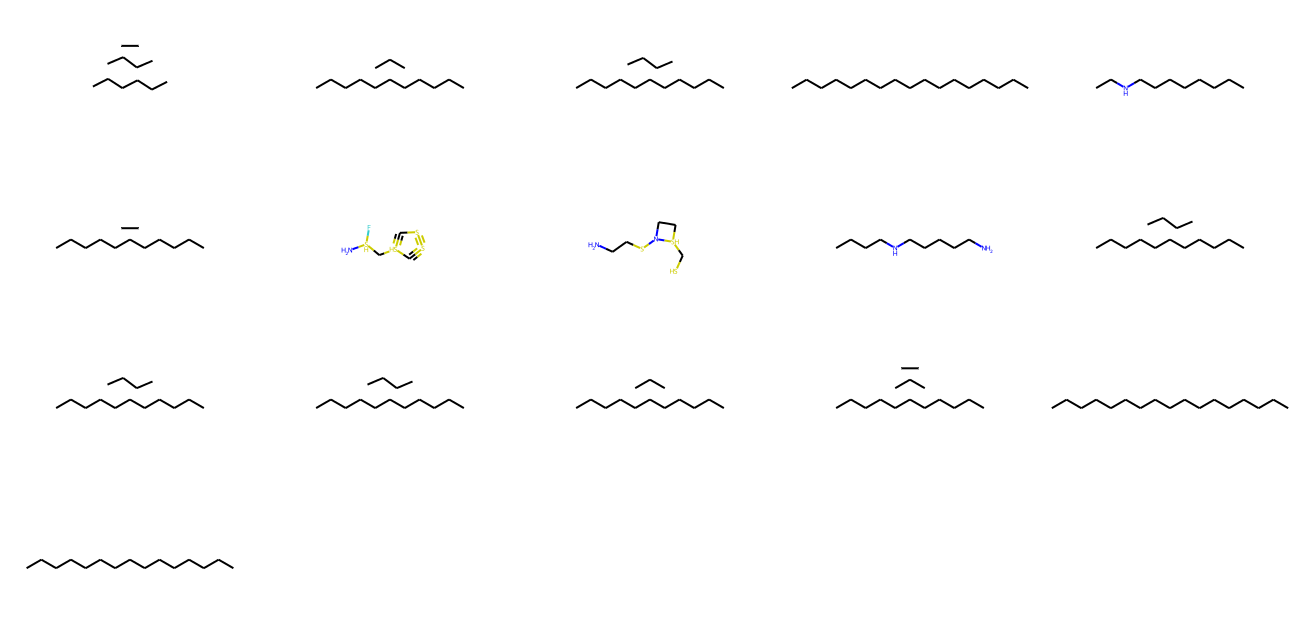
We use our model to generate new valid molecules from different points of the latent space.

Generate unique Molecules with the model

                                      molecules              =              model              .              inference              (              1000              )              MolsToGridImage              (              [              m              for              m              in              molecules              if              m              is              not              None              ][:              1000              ],              molsPerRow              =              5              ,              subImgSize              =              (              260              ,              160              )              )                      
png

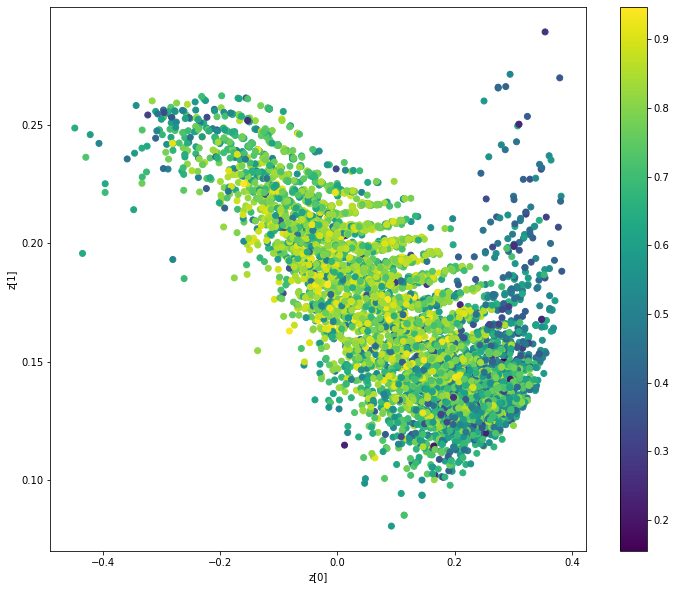
Display latent space clusters with respect to molecular properties (QAE)


                                      def              plot_latent              (              vae              ,              data              ,              labels              ):              # display a 2D plot of the property in the latent space              z_mean              ,              _              =              vae              .              encoder              .              predict              (              data              )              plt              .              figure              (              figsize              =              (              12              ,              10              ))              plt              .              scatter              (              z_mean              [:,              0              ],              z_mean              [:,              1              ],              c              =              labels              )              plt              .              colorbar              ()              plt              .              xlabel              (              "z[0]"              )              plt              .              ylabel              (              "z[1]"              )              plt              .              show              ()              plot_latent              (              model              ,              [              adjacency_tensor              [:              8000              ],              feature_tensor              [:              8000              ]],              qed_tensor              [:              8000              ])                      
png


Conclusion

In this example, we combined model architectures from two papers, "Automatic chemical design using a data-driven continuous representation of molecules" from 2016 and the "MolGAN" paper from 2018. The former paper treats SMILES inputs as strings and seeks to generate molecule strings in SMILES format, while the later paper considers SMILES inputs as graphs (a combination of adjacency matrices and feature matrices) and seeks to generate molecules as graphs.

This hybrid approach enables a new type of directed gradient-based search through chemical space.

Example available on HuggingFace

Trained Model Demo
Generic badge Generic badge

lantzhinsuff.blogspot.com

Source: https://keras.io/examples/generative/molecule_generation

0 Response to "Automatic Chemical Design Using a Datadriven Continuous Representation of Molecules Github"

Postar um comentário

Iklan Atas Artikel

Iklan Tengah Artikel 1

Iklan Tengah Artikel 2

Iklan Bawah Artikel